
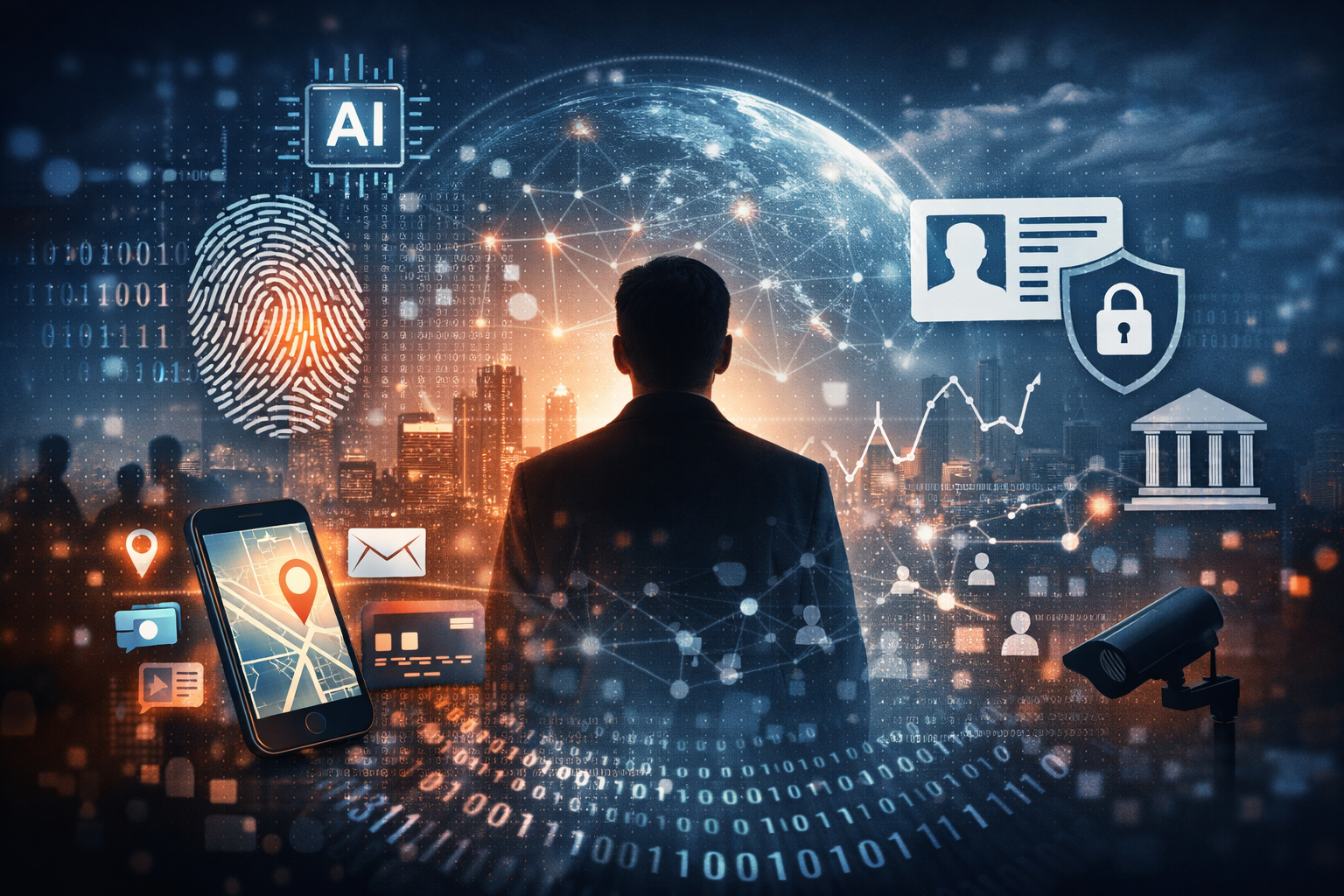
Every intelligence service seeks one thing: as much data as possible. Yet the real power of that data does not manifest at the moment of collection—it emerges later, when context matures and scattered fragments of information assemble into a coherent, revealing picture. This is not merely the privilege of intelligence agencies. Marketing, insurance, banking, financial institutions—all pursue the same objective, often packaged in the neutral acronym KYC: Know Your Customer.
But the question is not only how much data they have about you. The question is: what can they infer from it? And the answer is becoming increasingly uncomfortable.
KYC: More Than Just a Banking Form
When you enter a bank or insurance company today, you are asked for documents and signatures. That is the visible layer. The invisible layer is far more extensive: your transactions, spending patterns, locations, past decisions, responses to offers, payment delays. Together, these form a profile that is often more precise than your own self-perception.
Legal frameworks do exist—GDPR in Europe and various national laws. Some organizations comply; others test the limits. And some—particularly those operating in the grey zone between state interests and commercial logic—simply disregard those limits.
Knowledge about an individual does not reside solely in collecting raw facts. The key value lies in profiling: grouping people according to behavioral patterns, predicting decisions, segmenting populations. An individual’s digital footprint is not merely a list of websites visited. It is a dynamic portrait of who you are—and, perhaps more troublingly, who you will become.
“A digital footprint is not just a list of websites you have visited. It is a living portrait of who you are—and who you will be.”
Everyday Data: From Television to Telephone
In my academic work, I examined in depth how disparate data sources about an individual can be integrated: online behavior, television viewing habits, responsiveness to advertising, physical movement patterns. These processes generate vast quantities of unstructured data—and therein lies the challenge. Raw data in isolation is worthless. Value emerges only when it is filtered, refined, and synthesized into meaningful patterns.
This may sound technical, almost abstract. The consequences, however, are concrete. Consider recent examples from the Middle East, where intelligence services reportedly infiltrated roadside surveillance cameras and used artificial intelligence to predict the movements of high-ranking state officials. This was not chance or luck—it was systematic data collection and analysis of information most people would not even recognize as relevant.
What occurs at the level of geopolitics in such cases unfolds in a milder yet equally systematic form every day—with all of us.
Your Phone: An EDGE Device in Your Pocket—or a Monitoring Station?
The modern smartphone is a technological marvel. It is also one of the most comprehensive data-collection devices ever created. Built-in sensors—gyroscope, accelerometer, microphone, GPS, barometer, light sensor, proximity sensor—continuously register your environment and behavior. Because today’s phones are powerful EDGE devices capable of local processing, collected data can be pre-processed before only condensed, interpreted information is transmitted to the cloud.
This means you are dependent on whom you trust—and whether you even know which applications you have granted which permissions.
The question is not merely whether someone is listening. The question is whether your phone—without your awareness—is constantly constructing a contextual model of your life: when you wake up, how fast you walk, your breathing patterns, which locations you visit, whom you meet. And how much of this you already share, consciously or unconsciously, with applications to which you granted permissions you never fully read.
“Your phone does not only record what you do. It records how you do it—and why.”
Digital Identity: Asset or Trap?
Digital identity is becoming critical infrastructure of modern life. Access to banking services, health records, state documents, educational platforms—all is migrating into the digital sphere. Slovenia, as part of the EU, is progressing along this path alongside other member states. The European Digital Identity framework (eIDAS 2.0) promises security, interoperability, and control over one’s own data.
Yet a paradox emerges: when everything is digital, the footprint becomes more comprehensive, more traceable, and more persistent than ever before. In the analog world, you paid in cash and the transaction disappeared. In the digital world, every action leaves a trace—and those traces accumulate over time.
Whoever controls digital identity controls access to services. And whoever controls access wields power—not necessarily through overt coercion, but through the continuous, subtle shaping of what is available to you, what is recommended to you, and how the system perceives you.
The Historical Memory of Data: What Did You Ask Google Ten Years Ago?
Consider this: what did you search for on Google two years ago? Five? Ten? You likely do not remember. Google does. And so does every service to which you have ever entrusted a fragment of your attention or personal data.
In isolation, this information may not seem dangerous. But combined with other sources—purchasing habits, health queries, location data, social contacts—it forms a longitudinal profile whose value grows exponentially over time. Today, it may seem insignificant that you searched for information about a specific medical condition in 2015. In ten years, with more advanced AI models and richer contextual data, that query could become part of a profile an insurance company considers when determining your premium.
Here lies the core issue: the data we generate today will acquire meaning in the future—with tools we do not yet know. One defining feature of data in the age of artificial intelligence is that its value is not static. It increases in proportion to the analytical capabilities of the systems processing it.
“The data you generate today will acquire meaning only in the future—with tools we have yet to know.”
What You Can Do—and What You Cannot
Complete digital invisibility in the modern world is not realistic—at least not without drastic compromises in quality of life. However, awareness and a degree of control are attainable. Sound digital hygiene includes:
→ Regularly reviewing which applications have which permissions (location, microphone, contacts, camera).
→ Using two-factor authentication wherever available.
→ Separating devices by purpose—your work device should not be identical to your personal one.
→ Being selective with cookie and tracking consent—do not click “Accept all” without reflection.
→ Understanding that “free” services are not free. You pay with data.
→ Monitoring EU regulatory developments—eIDAS 2.0, the AI Act, and the forthcoming Data Act will shape your digital rights.
Conclusion: Control Is Responsibility
A world in which digital identity becomes the ticket to participation in social and economic life is not the future—it is the present. The question we must ask is not only “Who collects our data?” but also “Who benefits from our failure to understand it?”
In the coming years, artificial intelligence will become the primary instrument for extracting value from existing data repositories. Models trained on decades of your digital traces will be capable of predictions that exceed human intuition. This is not a conspiracy theory—it is a logical consequence of developments already underway.
The digital footprint does not disappear. It grows. And with it grows the responsibility—of individuals, companies, and states—to understand what we are doing with it. It begins with a simple question: how much of what we share today would we truly wish to explain to someone we will meet ten years from now?

Comments (0)
Join the conversation
Log in to share your thoughts and engage with other readers.
Log In to CommentNo comments yet
Be the first to share your thoughts!